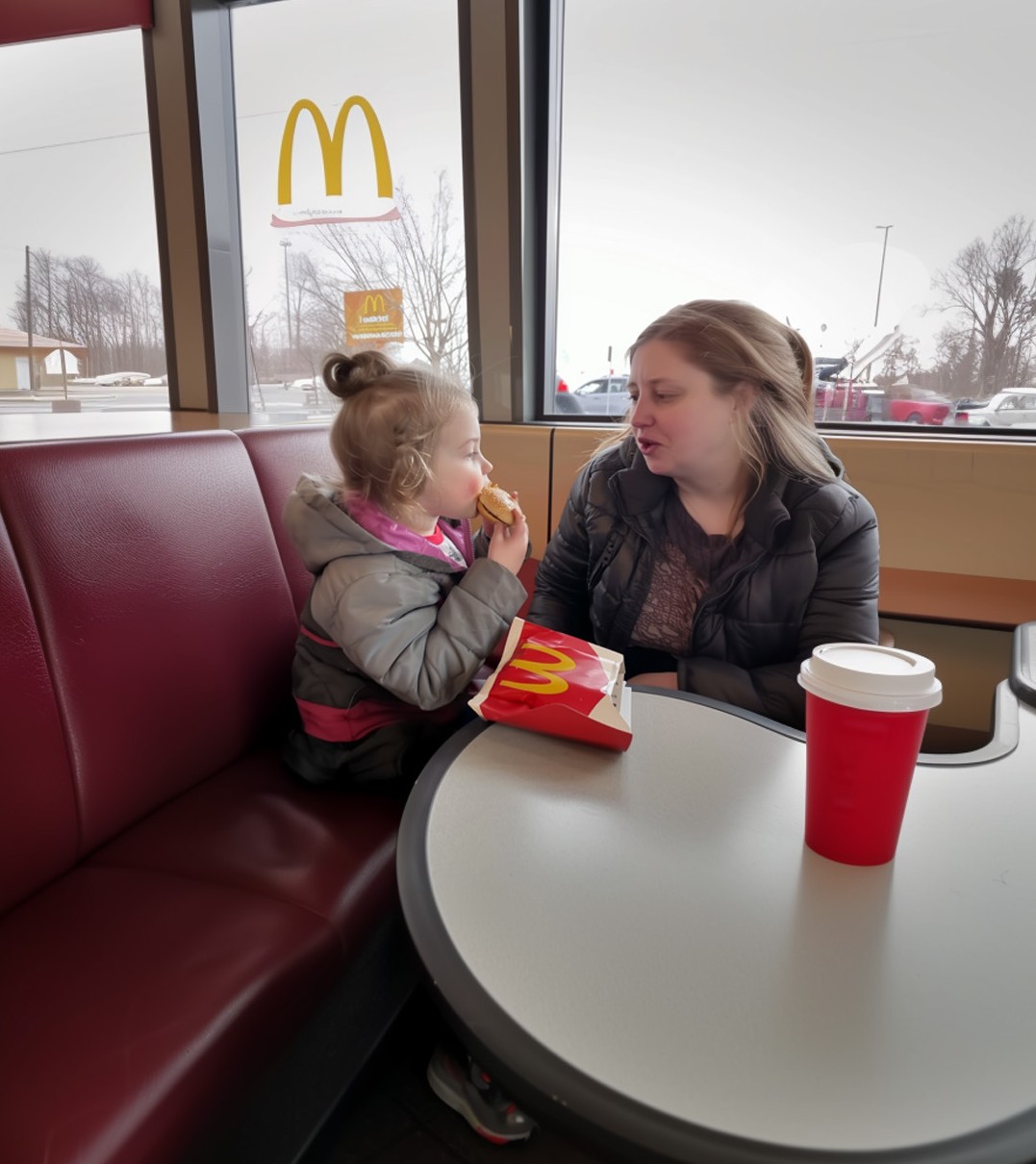
I stopped by McDonald’s for a quick bite, trying to shake off the stress of a long day. As I waited for my order, I noticed a woman and a little girl entering the restaurant. The girl couldn’t have been more than six or seven, her hair tied back into two messy braids. She clutched her mother’s hand tightly, her eyes lighting up as she scanned the bright, colorful menu.
The little girl whispered, almost too softly to hear, “Can we eat here, please?”
The mother hesitated. She looked around nervously, her worn clothes and tired eyes betraying the weight she carried. After a moment, she nodded, pulling out a small, crumpled wad of cash from her pocket. She approached the counter and ordered one hamburger. Just one.
They sat at the table next to mine. The girl’s excitement was palpable as her mother unwrapped the hamburger and split it in half, handing the larger piece to her daughter. The mom then reached into her bag and pulled out a small thermos, pouring what looked like tea into a plastic cup she had brought from home.
I couldn’t help but overhear bits and pieces of their conversation. They had come from the hospital. The mother spoke softly, her voice heavy with exhaustion. She mentioned how the bus fare had left them with just enough money for one burger, but she didn’t mind. Her daughter had never been to McDonald’s, and the mother wanted to give her at least a small piece of that joy.
As I sipped my coffee, I felt a lump forming in my throat. There was something about the mother’s weary face and the daughter’s innocent joy that struck me deeply. I tried to imagine what kind of struggles had brought them to this moment, but nothing could prepare me for what I would later learn.
I stood up, walked to the counter, and ordered a Happy Meal. As I approached their table, the mother looked up at me, startled, and before she could say much, I placed the meal in front of them.
“This is for her,” I said softly, nodding toward the little girl.
The girl’s eyes widened, and a smile spread across her face. “Thank you, mister!” she said, her voice so full of gratitude it nearly broke me. I nodded quickly and walked away before I could get too emotional. But as I left the restaurant, I couldn’t stop thinking about them. Something about their situation lingered in my mind.
The next day, I couldn’t shake the memory of the woman and her daughter. On a whim, I decided to stop by the hospital they had mentioned, hoping to learn more about them. I wasn’t even sure why I felt so compelled—it was just a hunch, an instinct that told me their story needed to be heard.
After asking around for a while, I found a nurse who recognized my description of the woman and her daughter. Her face softened with sympathy as she told me their story.
The mother’s name was Maria. She had been coming to the hospital regularly for months. Her daughter, Lily, had been diagnosed with leukemia. They lived in a small, rundown apartment on the outskirts of town. Maria worked long hours cleaning offices, but between rent, medical bills, and transportation to the hospital, there was barely anything left for food.
The nurse sighed and continued, “Maria used to be a teacher, you know. She loved her job, but when Lily got sick, she had to quit to take care of her. She’s been doing everything she can to make ends meet, but it’s never enough. She’s drowning in debt. Most days, she doesn’t even eat so Lily can have enough.”
Hearing this, I felt a pang of guilt. The Happy Meal I’d given them the day before felt like such a small gesture now, barely a drop in the ocean of what they needed. I thanked the nurse for sharing their story and left the hospital, my mind racing with emotions.
Over the next few weeks, I couldn’t stop thinking about Maria and Lily. I started visiting the McDonald’s more often, hoping to see them again. And one day, I did.
They were sitting at the same table as before, Maria carefully counting her change while Lily hummed softly to herself. This time, I didn’t hesitate. I approached them and introduced myself. Maria looked wary at first, but as I explained that I’d heard their story and wanted to help, her expression softened.
We talked for hours that day. She told me about her life before Lily’s illness—how she used to love teaching, how she had dreams of traveling one day. But all of that had been put on hold. Now, her entire world revolved around her daughter.
“Lily’s a fighter,” Maria said, tears brimming in her eyes. “She keeps me going. But some days… some days, I feel like I’m failing her.”
“You’re not failing her,” I said firmly. “You’re doing everything you can.”
Maria smiled weakly, but I could see the exhaustion etched into her face.
Over time, I tried to help in small ways. I brought them groceries, covered a few bus fares, and even found a way to anonymously pay for some of Lily’s medical bills. Maria always thanked me, but I could see how hard it was for her to accept help. She was proud, even in the face of such hardship.
One day, as I sat with them at McDonald’s, Lily tugged on my sleeve. “Thank you for helping my mommy,” she said, her voice sweet and sincere. “She’s really tired, but she loves me a lot. I know she does.”
I nodded, my throat too tight to speak.
Maria looked at me, her eyes filled with tears. “I just want her to have a childhood,” she whispered. “Even if it’s just one Happy Meal at a time.”
Maria and Lily’s story reminded me of the quiet strength so many people carry. Their struggle was a testament to the lengths a mother will go for her child. And while I couldn’t change their entire world, I hoped that, in some small way, I had helped lighten their burden—even just for a moment.
Leave a Reply